Tim
2026-07-14

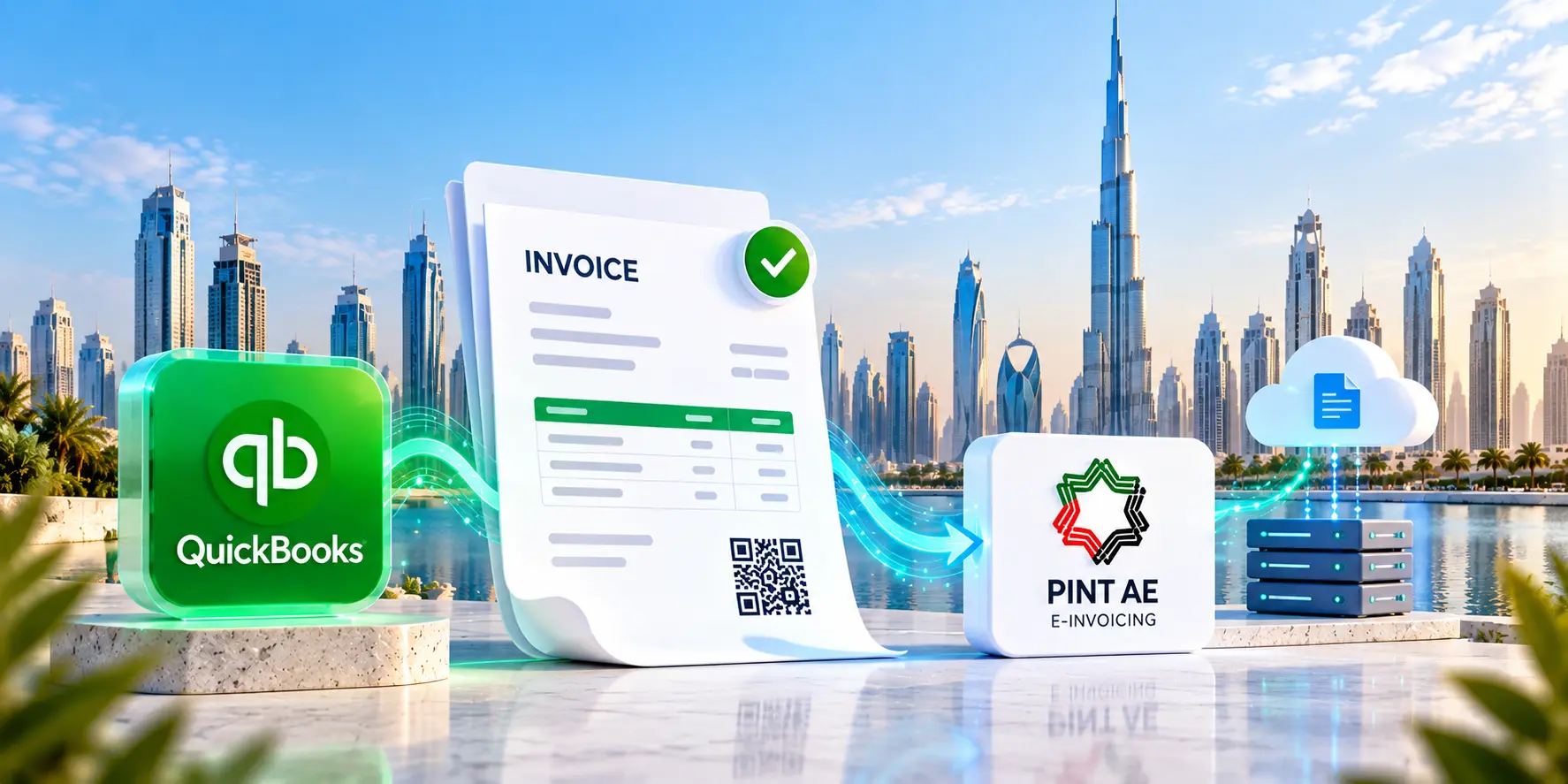
E-invoicing is easy to misunderstand. A proper electronic invoice is structured, machine-readable data (typically XML) created, exchanged, and reported through the approved system so that software can process it without somebody retyping the figures.
The UAE’s pilot and voluntary phase began on 1 July 2026. Businesses that have annual revenue of at least AED 50 million are required to appoint an Accredited Service Provider by 30 October 2026 and implement the system by 1 January 2027. Businesses below that threshold follow in 2027, while government entities have their own timetable on 1 October 2027.
The reason to act now is the preparation time. As per the Ministry of Finance, e-invoicing applies to people conducting business in the UAE. Their VAT registration status doesn’t matter unless it is excluded specifically. Implementation follows the phased timetable under Ministerial Decision No. 244 of 2025. That’s why businesses need clean customer records, accurate tax codes, consistent item units and a working Accredited Service Provider, or ASP, connection before their deadline.
This is not simply a new button marked “send.” The UAE uses a five-corner model involving the supplier, the supplier’s ASP, the buyer’s ASP, the buyer and the Federal Tax Authority.
The Mandatory Fields in an Electronic Tax Invoice in the UAE
As per the government’s published document, these are the mandatory fields in an electronic tax invoice:
1. Invoice number
2. Date of the invoice
3. Invoice type code
4. Invoice currency code
5. Invoice transaction type code
6. Payment due date
7. Business process type
8. Specification identifier
9. Payment means type code
10. Seller’s name
11. Seller’s electronic address
12. Seller’s electronic identifier
13. Seller’s legal registration identifier
14. Seller’s legal registration identifier type
15. Seller’s tax identifier
16. Seller’s tax scheme code
17. Seller’s address line 1
18. Seller’s city
19. Country subdivision of the seller
20. Country code of the seller
21. Name of the buyer
22. Buyer’s electronic address
23. Buyer’s electronic identifier
24. Buyer’s tax identifier
25. Buyer’s tax scheme code
26. Buyer’s address line 1
27. City of the buyer
28. Country subdivision of the buyer
29. Country code of the buyer
30. Sum of invoice-line net amount
31. Invoice total amount without tax
32. Invoice total tax amount
33. Invoice total amount with tax
34. Amount due for payment
35. Tax-category taxable amount
36. Tax-category tax amount
37. Code of tax-category
38. Rate of tax-category
39. Invoice-line identifier
40. Invoiced quantity
41. Unit-of-measure code
42. Invoice-line net amount
43. Net price of the item
44. Gross price of the item
45. Item price base quantity
46. Tax-category code of the invoiced item
47. Tax rate of the invoiced item
49. Invoice-line amount in AED
50. Name of the item
51. Description of the item
The transaction-type code carries flags for free-zone transactions, deemed supplies, margin schemes, summary invoices, continuous supplies, disclosed-agent billing, e-commerce, and exports. AED line values also matter when an invoice uses another currency.
What to Look For
Compliance: Ask for demonstrated PINT-AE support, UAE transaction codes, seller and buyer identifiers, AED conversions, credit notes, validation responses, and Peppol or ASP connectivity. “VAT-ready” and “e-invoicing-ready” are not the same claim.
Integration: Trace where invoice data begins. It may come from sales, stock, POS, or an ERP. The tool should pull that data without repeated entry, return acceptance or rejection messages, and retain the final status against the original invoice.
Growth: Count companies, branches, currencies, users, and monthly documents. Choose around transaction complexity, not office size.
Support: UAE implementation knowledge matters a lot. Ask who handles mapping, testing, rejected documents, staff training, and ASP coordination.
1. Elate E-Invoicing Software
Elate is positioned as a complete e-invoicing software that covers the practical invoice cycle. It includes creating, validating, tracking, and storing electronic invoices while supporting the UAE’s Peppol-based direction and PINT-AE requirements.
On compliance, its UAE focus is the main attraction. The system is designed around FTA-aligned workflows, VAT-ready invoice information, and ASP connectivity. This makes the conversation less about adapting a generic global setup and more about configuring a UAE process properly.
For integration, Elate can stay between your existing accounting or ERP data and the compliant invoice exchange process.
Its growth case is straightforward. Companies can expand invoice volume and operational complexity without treating e-invoicing as a separate manual task. Local implementation and support also give finance teams a clearer place to take on mapping, testing, and rejection questions.
2. Zoho Books
Zoho Books combines invoicing with cloud accounting, customer and vendor records, banking, expenses, reporting and tax functions. Its UAE edition supports VAT-compliant documents, VAT treatment, place-of-supply details and FTA-format VAT reporting.
From a compliance angle, Zoho Books already encourages structured recordkeeping rather than invoice-only bookkeeping.
Integration is one of its practical strengths. Businesses using other Zoho applications can connect finance with CRM, expenses, inventory and wider workflows.
Zoho Books suits businesses that want room to grow without moving immediately into a large enterprise ERP.
3. SAP
SAP fits businesses where invoicing is already tied to procurement, sales, tax, supply chain, and complex approval structures. Its UAE tax-invoicing capabilities include receiving, validating, transforming, and transmitting invoice data through SAP Business Network. SAP has also become a pre-approved UAE e-invoicing service provider.
Compliance can be managed inside a broader enterprise environment, reducing the need to pull tax data out of operational systems. Integration is where SAP makes the most sense. Multi-company operations, large transaction volumes and detailed permissions are its familiar territory.
4. Oracle NetSuite
Oracle NetSuite is a cloud ERP covering finance, orders, inventory, procurement, CRM and multi-entity management. Its Electronic Invoicing SuiteApp provides a framework for outbound and inbound XML or JSON documents, including invoices, credit memos, bills and purchase-related records. It also keeps an audit trail of generated, sent, received and converted documents.
Its integration strength comes from keeping invoicing inside the same platform as accounting, inventory and order management.
NetSuite is well suited to growing groups with subsidiaries, currencies, and consolidated reporting needs. Cloud deployment and role-based workflows also support distributed teams and controlled approvals.
5. TallyPrime
TallyPrime is a reliable choice for many UAE trading, service, and distribution businesses because its accounting, VAT, inventory, and invoicing stay close together.
On compliance, TallyPrime’s value starts with accurate VAT records, invoice details, and transaction-level accounting.
TallyPrime supports growth through multi-company accounting, inventory controls, and reporting without making everyday entry feel unfamiliar. UAE partner support is especially useful for configuration, migration, user training, and e-invoicing testing.
Conclusion
The best UAE e-invoicing tool is not necessarily the one that has the longest feature page. It is the one that can take your real transaction data, like untidy customer records, branch rules, credit notes, approvals, and all, and turn it into valid structured invoices consistently.
You can choose after testing one real invoice from creation to buyer delivery. A clean end-to-end test tells you far more about the software.
Latest News
From Our blog and Event fanpage


newsletter
Free consultation